
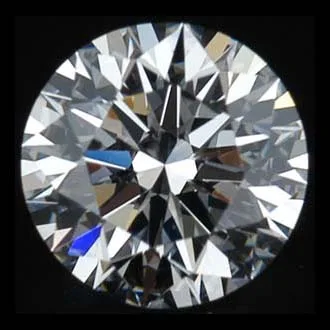
Most Diamonds used as gemstones are colorless or very faintly colored. However, colored Diamonds, known as "fancies", can be extremely rare and valuable, and the most valuable gemstones ever known have been fancy Diamonds. In fact, fancy Diamonds are the most valuable substances known to man, with vivid colored Diamonds historically being sold for more than a million dollars per carat!
About
The most typical color used for Diamond jewelry is colorless. However, most Diamonds have a light tint, usually yellowish or brownish. Perfectly clear Diamonds are much more valuable than their lightly tinted counterparts. Although light yellow tinting is frowned on, a deep yellow color renders the Diamond as a fancy. Fancy yellow Diamonds have recently increased in popularity in jewelry. "Fancy", the term used to describe any deeply colored Diamond, not only includes the more common yellows and browns, but it also is used to describe the very rare tones of red, pink, purple, blue, and green. Black Diamonds, which are more common and less expensive, are occasionally faceted as opaque yet shiny gems. (For additional information on fancy Diamonds, please visit our Colored Diamond Shoppers Guide and our article titled "How are Natural Fancy Colored Diamonds Created".)
Roughly twenty percent of Diamonds mined are used in jewelry, as most are unsuitable for gemstone use. The vast majority are either opaque and not gem quality, or are too heavily flawed. A flawless Diamond is exceptional, as most Diamonds gemstones contain some level of flaws, even if they are very minute.
The immense hardness of Diamond contributes to its suitability and importance as a gemstone. Because of its hardness, a Diamond is immune to scratching, as the only thing that can scratch it is another Diamond. This resistance lends it the ability to withstand daily wear and tear beyond the capabilities of most gemstones. Diamonds are also difficult to polish due to their hardness - they can only be polished with special Diamond saws that have a thin layer of Diamond on the saw blades and edges.
A grading system, instituted by the GIA, was implemented to evaluate Diamonds based on four aspects. These four grading systems are known as "the four C's", in which all Diamonds are evaluated:
Color
Cut
Clarity
Carat weight
Color:
The color of a Diamond is graded on an alphabetical scale ranging from the letters D to Y. This scale measures the color saturation, ranging from absolutely colorless to deep yellow (or yellow-brown). D is totally colorless, without a hint of any other color. Y indicates an intense deep yellow or deep yellow-brown. The letters between D and Y describe the color, depending on the amount of yellow saturation. The color bar below depicts the letter and the color saturation it represents. (The bar is not limited to yellow; it may also be yellow-brown, and is not necessarily accurate as monitor saturation may vary.) The letter Z in the color grade of a Diamond may sometimes be used to indicate a fancy Diamond.


Cut:
The cut, or facet of the Diamond, is the shape and style in which it is cut. The most prevalent cut is the brilliant cut, a facet specially designed to bring out the most fire in the stone. Sometimes this cut cannot be given, either because of flaws or cleavage habits. Much planning must be taken before cutting a Diamond, as a slight error in the facet may significantly decrease the value of the stone.
Clarity:
Clarity is graded on the size and visibility of the flaws and inclusions. Letters are assigned to a stone to label the quality of its clarity:
| FI | Flawless | Contains no flaws or inclusions at all |
| IF | Internally Flawless | Contains no flaws or inclusions at a magnification of 10x |
| VVS1 | Very, very small inclusions | Contains very tiny flaws or inclusions visible at 10x magnification |
| VVS2 | Very, very small inclusions | Contains tiny flaws or inclusions visible at 10x magnification |
| VS1 | Very small inclusions | Contains small flaws or inclusions visible at 10x magnification |
| VS2 | Very small inclusions | Contains flaws or inclusions visible at 10x magnification |
| SI1 | Small inclusions | Contains larger flaws or inclusions visible at 10x magnification |
| SI2 | Small inclusions | Contains larger flaws or inclusions easily visible at 10x magnification |
| I1 | Inclusions | Contains inclusions visible to the naked eye |
| I2 | Inclusions | Contains large inclusions visible to the naked eye |
| I3 | Inclusions | Contains very large inclusions visible to the naked eye |
Carat Weight:
The size of a Diamond is measured in carats (abbreviated as ct). A carat is equivalent to 0.2 grams (about 0.007 ounces). Another weight measurement sometimes used for small for Diamonds is the point measurement (abbreviated as pt). Each point is one/one hundredth of a carat. For example, a stone weighing 34 pt weighs .34 ct Larger Diamonds are worth more than proportionally smaller ones, meaning a 3 ct Diamond surpasses the value of three 1ct Diamonds.
Diamonds (as well as other precious colored gemstones) are often sold together with a certification document that lists comprehensive details about the stone, especially their 4 C's. These certificates are usually certified by recognized organizations such as the GIA and AGS (American Gem Society) and provide authenticity on the purchased stone. Diamonds that are certified have a premium over non-certified stones.
Diamonds are very difficult to synthesize, as their formation requires immensely high temperatures and pressure to form. However, the technology does exist to product synthetic Diamonds, but the output of these synthetic Diamonds is relatively limited due to the high costs involved in producing them.
Advertisement
Uses
Diamond is the birthstone for April.
Please also visit our special page titled "Top Tips for Diamond Buying."
Varieties
✓ generally accepted · ✗ less commonly used
- Black Diamond— Black opaque Diamond with a shiny submetallic luster that is occasionally used as a gemstone.
- Bort— Dark colored, imperfectly crystallized, opaque Diamond. May also refer to a fragment of a gem quality Diamond.
- Canary Diamond— Diamond with a deep yellow color.
- Fancy— Refers to colored Diamonds such as blue, red, pink, purple, and
green, as well as deep yellow and deep brown. Fancy Diamonds are
extremely rare and sought after.
False Names
- Arkansas Diamond
- Baffa Diamond
- Bristol Diamond
- Cape May Diamond
- Cornish Diamond
- Dauphine Diamond
- Herkimer Diamond
- Hot Springs Diamond
- Marmorosch Diamond
- Pecos Diamond
- Vallum Diamond
- Zabeltitzen Diamond
There are other false names used not referring to Quartz. They are as follows:
- Alaska Black Diamond - Hematite
- Jourado Diamond - Colorless synthetic Spinel
- Killiecrankie Diamond - Colorless Topaz from Killiecrankie Bay on the northern end of Flinders Island, Australia.
- Matura Diamond - Colorless Zircon
- Strass Diamond - Colorless glass used as a gemstone simulant
- Swarovski Diamond - Highly lustrous form of glass