
About
The brilliant luster and fire of Zircon, combined with its good hardness and range of colors, make it a most desirable gem. However, it does have some undesirable traits. An interesting and strange habit exhibited in only few Zircons is that their color darkens and their luster dulls upon prolonged exposure to sunlight. This effect can be reversed by giving the stones a second heat treatment. Zircon is also prone to cracking and chipping if banged too hard. For this reason, care must also be taken when faceting Zircon gemstones. Another important factor when faceting Zircon is to minimize the appearance of its strong double refraction by cutting along proper angles. Zircons that are not faceted propely can appear blurry, due to strong double refraction.
Zircon is sometimes confused with Cubic Zirconia. Cubic Zirconia, a synthetic, inexpensive Diamond simulant, resembles colorless Zircon and has a similar sounding name. However, the two are entirely separate substances, and have no connection with each other except for the fact that they both contain the element zirconium in their chemical structure.
Advertisement
Uses
Zircon is the traditional birthstone for December.
Varieties
✓ generally accepted · ✗ less commonly used
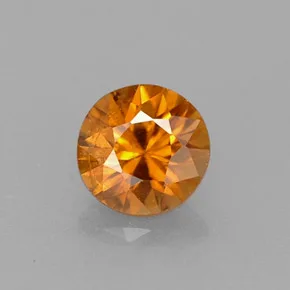
- Jacinth— Yellow, orange, brown, or red variety of Zircon. Also synonymous with Hyacinth. Though the terms Jacinth and Hyacinth are no longer used in the gem trade, they are historically important names going back to biblical times. In ancient times, before there were mineralogical classifications for gemstones, the term Hyacinth may also have referred to an orange or brownish Topaz.
- Jargon— Colorless, pale gray, or pale yellow variety of Zircon.
- Matura Diamond— Trade name for colorless Zircon.
- Starlite— Blue gem variety of Zircon. The color of Starlite is rarely natural, and is almost always heat treated.
Treatments & Enhancements
Sources
Similar Gemstones
Colorless Zircon resembles Diamond. It also resembles synthetic Diamond simulants such as Cubic Zirconia and Strontium Titanate. It is distinguished from these and other colorless gem forms by its strong double refraction.
Blue Zircon can be similar to Aquamarine, Blue Topaz, Blue Tourmaline, and Blue Spinel; Golden-brown Zircon can be similar to Topaz, Citrine, and Sapphire; Yellow zircon can be similar to Yellow Diamond, Yellow Sapphire, Golden Beryl, Chrysoberyl, and Topaz; and Pink Zircon can be similar to Rose Quartz, Morganite, Kunzite, Spinel, and Pink Topaz.
The luster, fire, and double refraction make Zircon gemstones distinguishable from most others.