
About
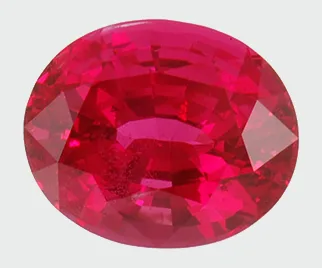
Fine red Spinel is actually rarer than Ruby of equal color. However, its is an undervalued gemstone, with its cost is about 30% lower then comparable Ruby. The scarcity of good Spinel is the reason for its lack of demand and popularity. Gem Spinel is in very limited supply, and therefore jewelry companies and gem cartels don't really market this gemstone to the consumer. This inhibits Spinel from being a more mainstream gemstone.
Spinel is easily synthesized, and can be made into any color by adding impurities. Synthetic Spinel is often simulated to replicate many other gemstones such as Diamond, Sapphire, and Zircon. Because of the abundance of synthetic Spinel, one must always be careful only to purchase this gemstone from reputable dealers. Almost all colorless Spinel gemstones are synthetic, as it rarely occurs colorless in nature.
Advertisement
Uses
Spinel naturally occurs in octahedral crystals. In well-shaped red crystals, gem cutters may even out a crystal into a perfect octahedron. These "crystals" are occasionally be worn in jewelry without any further faceting.
Varieties
✓ generally accepted · ✗ less commonly used
- Almandine Spinel— Spinel with a violet to violet-blue color.
- Balas Ruby— Spinel with a pink to pale red color.
- Blue Spinel— Light to dark blue variety of Spinel.
- Flame Spinel— Orange to orange-red Spinel.
- Gahnospinel— Zinc-rich form of Spinel, usually with a dark green to greenish-black color.
- Picotite— Brown form of Spinel.
- Pleonast— Opaque, dark blue or green to black variety of Spinel.
- Rubicelle— Yellow to orange form of Spinel.
- Ruby Spinel— Ruby-red variety of Spinel.
Treatments & Enhancements
Sources
Similar Gemstones
Blue Spinel may resemble Zircon, Topaz, and Sapphire; and pink Spinel may resemble Morganite, pink Topaz, and pink Tourmaline. Purple Spinel may appear similar to Amethyst, though Spinel is usually bluer in tone than Amethyst.