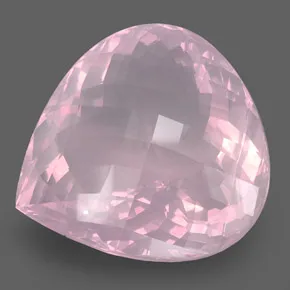
Rose Quartz is the rosy pink
variety of Quartz. Its color is usually soft, ranging from very
light pink to medium pink in intensity. It is often hazy or turbid, which makes it lack good transparency. Rose Quartz is fairly common and found in many places throughout the world, and can occur in very large examples in nature. This allows exceedingly large gemstones to be cut from it. The relative abundance of Rose Quartz, and its frequent lack of full transparency, diminish its importance as a pink gemstone in relation to other pink gemstones such as and Topaz, Tourmaline, and Kunzite.
About
Rose Quartz is a very affordable gemstone. Due to its often hazy color and frequent flaws, it is more often tumbled or used as beads over faceting into gemstone cuts. A deeper pink color in Rose Quartz makes it less common and more desirable, though certain forms of Rose Quartz may fade upon repeated
prolonged exposure to strong lighting. Asterism in Rose Quartz, in the form of a six-ray star, does occur but is rare.
Advertisement
Uses
Rose Quartz is a minor pink gemstone. It sometimes cut as cabochons or hearts, and is often tumbled or made into beads for use in bracelets, necklaces, and as costume jewelery. Large spheres and carvings are also cut from Rose Quartz.
Rose Quartz gemstones are generally colored naturally and not treated.
Sources
The chief source of Rose
Quartz is Brazil, though it is also prevalent in Madagascar, South Africa, Mozambique, India, and the United States (Maine and South Dakota).
Similar Gemstones
Rose Quartz is similar to Kunzite, but is often cloudier and lacks the dichroism present on Kunzite. Pink Tourmaline, pink Topaz and pink Spinel are generally more intensely colored and with greater transparency.