
About
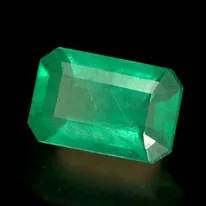
Emeralds are notorious for their flaws. Flawless stones are very uncommon, and are noted for their great value. Some actually prefer Emeralds with minute flaws over flawless Emeralds, as this proves authenticity. Flaws are often hidden by treating the Emeralds with oil or synthetic lubricants, and this is a common practice in the industry. Though Colombian Emeralds have traditionally been the highest quality Emeralds with the finest green color, a new source of Emerald from the African country of Zambia has been producing deep green Emeralds with fewer flaws.
Many Emerald fakes and doublets are known. Two pale colored stones may be glued together with a deep green paste, creating a stone resembling Emerald. Faceted green glass also resembles Emerald, and it may be coated with a hard substance to mask its low hardness. Synthetic Emeralds are also sold to unwary buyers without them knowing the stone is synthetic. Experts can distinguish all these fakes, and it is especially important to only purchase Emeralds from reliable dealers. Experts can also determine if an Emerald was treated with oil or a lubricant to mask internal flaws.
A rare and unusual form of Emerald, known as "Trapiche Emerald", is characterized by star-shaped rays that emanate from the center of a stone in a hexagonal pattern. These rays appear much like asterism, but, unlike asterism, are not caused by light reflection from tiny parallel inclusions, but by black carbon impurities that form in a star-shaped pattern. These Trapiche Emeralds are only found in the Boyaca Emerald mining district of Colombia, and are cut into cabochons.
Though Emerald has good hardness, it is a brittle stone. It may develop internal cracks if banged hard or if subject to extreme temperature change. Emeralds that were treated to mask internal flaws should never be cleaned with an ultrasonic jewelry cleaner, nor should they be washed with soap. These practices may remove the oiling treatment and expose the hidden internal flaws.
Advertisement
Uses
Emerald is the birthstone of May.
Varieties
✓ generally accepted · ✗ less commonly used
- Brazilian Emerald— Emerald from Brazil. The term Brazilian Emerald may also refer to green Tourmaline from Brazil.
- Cat's Eye Emerald— Emerald exhibiting cat's eye effect. Cat's eye emerald is very rare, and only exists on paler Emeralds.
- Colombian Emerald— Emerald from Colombia. This Emerald is usually regarded as the highest quality.
- Star Emerald— Synonym of Trapiche Emerald.
- Trapiche Emerald— Emerald with black impurities in the form of a six-rayed star.
- Zambian Emerald— Emerald from the African country of Zambia. Zambian Emeralds can have very good color and transparency.
False Names
- Biron Emerald
- Chathan Emerald
- Gilson Emerald
- Kimberly Emerald
- Lennix Emerald
- Linde Emerald
- Regency Emerald
- Zerfass Emerald
Glass dyed green is also a major Emerald simulator. The color of green glass and emerald may be identical, but other physical and optical properties can easily differentiate the two. Some fraudulent names given to green glass used as jewelry:
- Broghton Emerald
- Endura Emerald
- Ferrer's Emerald
- Medina Emerald
- Mount St. Helen's Emerald
- Spanish Emerald
Other false emerald names include:
- African Emerald - Green Fluorite
- Bohemian Emerald - Green Fluorite
- Cape Emerald - Prehnite
- Congo Emerald - Dioptase
- Emeraldine - Chalcedony dyed green
- Emeraldite - Green Tourmaline
- Evening Emerald - Peridot
- Indian Emerald - Quartz or Chalcedony dyed green
- Lithia Emerald - Hiddenite
- Mascot Emerald - Emerald doublet
- Night Emerald - Peridot
- Oriental Emerald - Green Sapphire
- South African Emerald - Green Fluorite
- Tecla Emerald - Emerald doublet
- Traansvaal Emerald - Green Fluorite
- Uralian Emerald - Demantoid Garnet