
About
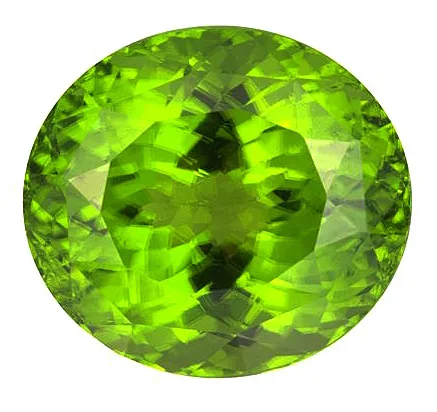
Findings of large transparent Peridot from Burma (Myanmar), China, Afghanistan, and especially Pakistan have provided a new quality of Peridot unlike anything else previously discovered, with large, nearly flawless crystals that are well-suited for gemstones. The new discoveries are responsible for a reawakened interest in this gemstone. However, the most significant producer of gem Peridot remains the San Carlos Reservation of Arizona.
Although many Peridot gemstones, especially older ones, have cloudy or milky inclusions, the more recent gemstones on the market have few flaws and can be of exceptional quality. Though pretty and popular, Peridot is not a very durable gemstone. It has a lower hardness than many gemstones and is more prone to scratches, and has a tendency to occasionally burst under great stress. Peridot also cannot stand intense heat or rapid temperature changes. Peridot can also chip if banged hard, and should never be steam cleaned or cleaned with ultrasonics.
Much gem Peridot comes from igneous environments. These gems are formed deep within the mantle of the earth, and are brought the the surface by volcanic activity. Peridot is also found in certain types of meteorites, though these forms of Peridot are too rare and usually too small to be used as gemstones.
Peridot is both a day stone and a night stone, keeping its shining color even under artificial lighting. For this reason, it is sometimes called "Evening Emerald". Although Peridot can be pronounced both with and without the "t" at the end, most professionals in the gem trade pronounce the "t".
Advertisement
Uses
Peridot is the birthstone of August.