
About
Pure Gold lacks resistance to pressure and easily bends. For this reason, Gold jewelry is always alloyed with other metals to increase its toughness and durability. The purity of Gold depends on the percentage of alloyed metal, and this number is measured in karats. The karat measurement determines the percentage of gold to other metals on a scale of 1 to 24, with 24 karats being pure gold. Common karat weights are 22 kt (91.67% gold), 18 kt (75% gold), 14 kt (58.33% gold), and 10 kt (41.67% gold). Pure 24 kt Gold is never used in jewelry as it too flexible and will be bent and mishaped even by minor touches.
Several different metallic elements are alloyed with Gold, and some are used specifically to produce a certain color or tone in the Gold. The main metals alloyed with Gold are copper, silver, palladium, nickel, zinc, and iron. White Gold, which has become very popular in jewelry, is mainly alloyed with nickel and zinc, and occasionally palladium. White Gold resembles the color of Silver, but it is far more resistant to corrosion and will not tarnish like Silver. Rose Gold, which has a slightly reddish tone, is alloyed mostly with copper. Green gold, which appears greenish-yellow, is alloyed with silver, and Blue Gold, which is gold with a whitish-blue tone, is alloyed with iron.
Some gold-colored jewelry is made out of cheaper metals and coated with a very thin layer of Gold. Such jewelry is known as "Gold-plated". Through normal wear, the layer of gold can erode if it is too thin, exposing the underlying metal.
Gold is one of the heaviest substances on earth. When pure, it has a specific gravity of 19.3. The international weight measurement of Gold is the troy ounce. One troy ounce of gold equals 31.1 grams.
Advertisement
Uses
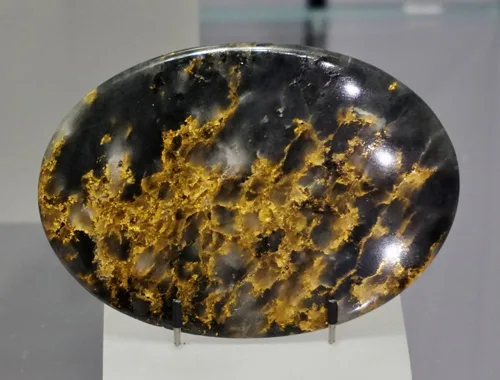
Picture Rock, which is a white Quartz with Gold veins is occasionally polished into cabochons, creating a rare and unusual gem.
Varieties
✓ generally accepted · ✗ less commonly used
- Blue Gold— Gold with a slightly bluish tone, which is caused by alloying the Gold with iron.
- Green Gold— {$Gold%} with a slightly greenish tone, with the color caused by alloying the Gold with copper and silver.
- Rose Gold— Gold with a reddish tone, with the color caused by alloying the Gold with copper.
- White Gold— Pale, almost silver-colored Gold, with the color caused by alloying the Gold with nickel, zinc, and sometimes palladium.
- Yellow Gold— Gold that retains its original golden yellow color. Although it is alloyed with other metals to strengthen its tenacity, the original color is maintained.