
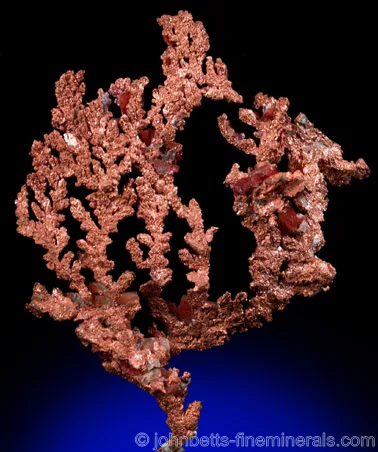
Crystallized Copper Dendrite
ISOMETRIC

Copper

Cu

Hardness
2.5–3
Spec. Gravity
8.9
System
Isometric
View Mineral
Copper is known for its metallic reddish-brown color. Though not a gemstone or precious metal, it is included here in this guide for its historical significance as an ancient metal. Ornaments, coins, and statues have been fashioned from Copper since ancient times. Its distinct color and availability throughout history have afforded it great significance, though in modern times Copper is almost exclusively an industrial metal.

About

Copper is notorious for its habit of developing a green oxidation tarnish on exposed surfaces, which is caused by exposure to weathering. If kept away from water and moisture, it will not tarnish. The green tarnish is sometimes known as patina, especially when referring to historic statues and objects where the antique nature is enhanced by tarnish.

Uses

Virtually all mined Copper goes towards electrical and plumbing use. Copper has always been important in coin minting, and continues to remain a standard in coins. (Prior to 1983, the U.S. penny was made mostly of copper, but it is now made entirely from zinc and only plated with copper.) Copper, as well as brass and bronze, are fashioned into utensils, ornaments, and statues, but are rarely used in jewelry. Care must be exerted with Copper ornaments to prevent oxidization. They should be stored away from humid areas, and if washed they should be dried immediately.

Varieties

common  ·  uncommon

Sources

The main copper producing countries by output are Chile, the U.S. (Michigan and Arizona), Peru, China, Australia, Indonesia, Russia, Canada (Ontario and British Columbia), Zambia, Poland, and Kazakhstan.

Similar Gemstones

Copper is unique in color; no metal has the same color. Brass and bronze, both copper alloys, are not as brightly colored as copper, and they don't oxidize like Copper.

Further Reading