
About
The original Crocidolite is a bluish-gray color, and sometimes the pseudomorphism to Quartz is incomplete. When this happens, the result is a stone with a bluish-gray color (and often with streaks or overtones of brown or yellow), but still with chatoyant effect. This type of material is known as as Hawk's Eye.
Tiger's Eye may form together with brownish-red or metallic-gray Hematite, or with yellow Limonite, where these minerals forms stripes, streaks, or patterns within the Tiger's Eye. Such material is often called Tiger's Eye Matrix.
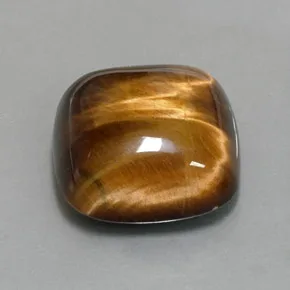
When cutting and polishing Tiger's Eye gemstones, skillful orientation to the fibrous structure must be applied to achieve the best chatoyancy. Ideally the cut should be perfectly parallel to the length of the fibers to achieve fullest chatoyancy. Cat's eye effect in Tiger's Eye do exist, but are uncommon in perfect form due to the wavy nature of the fibers.
Advertisement
Uses
Varieties
✓ generally accepted · ✗ less commonly used
- Hawk's Eye— Bluish-gray variant of Tiger's Eye, lacking the yellow or brown color. Hawk's Eye is formed from an incomplete pseudomorphism of Quartz after Crocidolite.
- Tiger's Eye Matrix— Tiger's Eye admixed with iron oxide lines or patterns. These include dark gray or red Hematite and yellow Limonite.
- Arizona Tiger's Eye— Quartz or Opal pseudomorph after fibrous Serpentine, found near Globe in Arizona.
- Blue Tiger's Eye— Synonym of Hawk's Eye
- Marra Mamba Tiger's Eye— Strongly chatoyant Tiger's Eye from the Hamersley Range in Western Australia, with a beautiful multicolored effect of reddish brown, steel-blue, yellow, and yellowish-green.
- Tiger Iron— Synonym of Tiger's Eye Matrix