
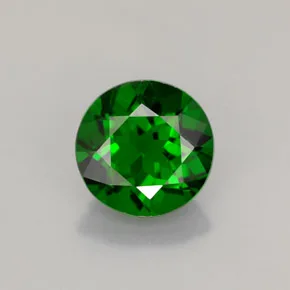
Chrome Diopside
MONOCLINIC

Diopside

CaMgSi2O6

Hardness
5–6
Refractive Index
1.665–1.730
Spec. Gravity
3.3–3.5
System
Monoclinic
View Mineral
Diopside has been regarded only as a collector's gemstone until recently, when the deep forest-green Chrome Diopside variety has made its way into the mainstream gemstone market. Although its intense green color rivals that of Emerald, its low hardness makes it prone to scratches, thus limiting it from overwhelming the gemstone industry.

About

Although Diopside occurs in a variety of colors, the green color is the most common form. A purple type known as Violane is occasionally used as a gemstone, and Star Diopside is very dark green to black. But the form of this stone that puts this gemstone on the map is the deep green Chrome Diopside form.

Chrome Diopside in limited quantity is known from several localities, but a large commercially exploitable deposit discovered in Siberia in 1988 made this gemstone readily available to the market. Since then, Pakistan has also become a signficant producer of Chrome Diopside.  Chrome Diopside is an affordable gemstone that has an intense forest-green color which rivals that of more expensive Tsavorite and Green Chrome Tourmaline.

Deep green color combined with transparency give a stone more value. Except in lighter colored stones, the faceting of larger cuts is generally avoided because the deep green color tends to make its tone too black. Careful cutting is also necessary in larger stones to keep the facet angles shallow to improve brilliance. The deep green color of Chrome Diopside is natural and not enhanced.

Uses

Chrome Diopside is faceted into gemstone cuts mainly for earrings and pendants. It is generally not used for rings and bracelet due to its low hardness. Star Diopside and the purple variety Violane are faceted into cabochons mostly as collectors gems.

Varieties

common  ·  uncommon

  • Chrome Diopside— Deep forest-green variety of Diopside. Its color is caused from traces of the element chromium.
  • Star DiopsideDiopside polished into a cabochon that displays asterism in the form of a four-rayed star. Its colors is usually very dark green to black.
  • Violane— Light blue to purple, manganese-rich variety of Diopside.
  • Tashmarine Diopside— Light yellowish-green form of Diopside from a recently exploited deposit in eastern Uzbekistan. This term was recently coined by the Columbia Gem House company in Vancouver.

Treatments & Enhancements

Diopside gemstones are natural and not heated or enhanced.

Sources

Diopside of facetable nature comes from Italy, Austria, Finland, Tanzania, Madagascar, Mynamar (Burma), China, and the U.S. (New York). The source of most gem {$Chrome Diopside%} is from Russia, but other deposits also exist in Pakistan, Afghanistan, and Finland. Violane is primarily from Italy, and Star Diopside from India.

Similar Gemstones

Further Reading

Faceted

In the Rough