
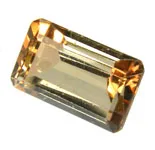
Large Emerald-Cut Andalusite
ORTHORHOMBIC

Andalusite

Al2SiO5

Hardness
7–7.5
Refractive Index
1.62–1.65
Spec. Gravity
3.1–3.2
System
Orthorhombic
View Mineral
Andalusite gemstones are remarkable for their fascinating color habits and very strong pleochroism, which can cause a muliticolored effect of shades of yellow, olive-green, and reddish-brown within a single gem. Although Andalusite as a mineral is not uncommon, the transparent variety used as a gem is very rare. Another important form of Andalusite that is entirely different is the mostly opaque Chiastolite variety, which is known for its unique cross-shaped design within the body of a crystal.

About

The strong pleochroic effect in transparent Andalusite exhibits itself with a display of colors when viewing a gemstone through different angles. The intensity of the colors also varies by the viewing angle. The cut of an Andalusite gem plays a critical role in how the color will display itself in a cut stone. Gemstones can be cut either in a long shaped or equant shape. Long cuts will allow gemstones to show one color near the center and a different color on the ends, and equant square or round cuts will allow the multicolored effect to blend in an interesting manner.

Uses

Andalusite is used a minor gemstone. Although it forms hard and resistant gemstones of beautiful color, deposits of gem quality material are not extensive enough to make Andalusite into a standardized gemstone. The cross-patterned Chiastolite variety is also used as a minor gemstone, and can be cut into rounded disc-like slices and polished.

Varieties

common  ·  uncommon

  • Chiastolite— Variety of Andalusite with a distinctive cross pattern (or occasionally a checkerboard pattern) that forms in the interior cross-section of a crystal.
  • Viridine— Bright green to olive-green variety of Andalusite, with its color supposedly caused by manganese impurities.

Treatments & Enhancements

Andalusite gemstones are generally not treated or enhanced.

Sources

The rare gem variety comes primarily from Brazil. Chiastolite comes from many locations worldwide, including Australia, China, Portugal, Russia, Spain, and the U.S. (California and Massachusetts).

Similar Gemstones

Further Reading

In the Rough