
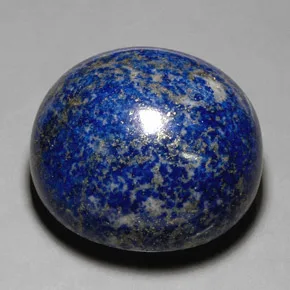
Lapis Lazuli
ISOMETRIC

Lapis Lazuli

The chief constituent Lapis Lazuli is Lazurite, with the following chemical formula:
(Na,Ca)8Al6Si6O24(S,SO)4

Hardness
5–5.5
Refractive Index
1.5
Spec. Gravity
2.4–2.5
System
Isometric
Lapis Lazuli is a deep blue opaque gemstone, used in antiquity and continuously used throughout the generations. It still continues to be popular today, and remains one of the most important opaque gemstones. Lapis Lazuli is chiefly composed of the mineral Lazurite, with additional other minerals including white Calcite and sparkling specks of Pyrite.

About

Lapis Lazuli is often called Lapis for short. In fact, the shorthand name "Lapis" is actually used more often to describe this gemstone than the full term "Lapis Lazuli". Lapis Lazuli is rarely without any of the white Calcite present. Embedded Pyrite crystals within most Lapis Lazuli add to the sparkle and naturalness of this gemstone, and when evenly distributed in small amounts makes it more desirable. A deeper blue color makes this gemstone more valuable, as well as a minimal amount of spotting or streaks of white Calcite.

Lapis Lazuli is a sensitive gemstone, and can be chipped or cracked easily when banged. It is also relatively soft so care should be exercised to prevent it from getting scratched. It is also slightly porous and should be protected from chemicals and cleaning solvents.

Uses

Lapis Lazuli, being an opaque gemstone, is cut into cabochons and beads, and used mainly in bracelets, necklaces, and pendants. Ornate carvings and utensils are also carved out of Lapis, especially animal carvings, snuff boxes, and talismans.

False Names

Treatments & Enhancements

The color of Lapis Lazuli is natural, and it is generally not treated or enhanced, though occasionally lighter colored stones may be dyed a deeper blue.

A synthetic simulant of Lapis Lazuli has been created using the Gilson process. Although Gilson Lapis may look similar to Lapis Lazuli, it not made of the same composition, and lacks the natural random patterns displayed in most true Lapis Lazuli. Howlite and Jasper may also be dyed an ultramarine blue to simulate Lapis Lazuli.

Sources

The most significant source of Lapis Lazuli is Afghanistan. Other commercial deposits are in Russia and Chile.

Similar Gemstones

Azurite is lower hardness and usually has a darker tint. Sodalite may be difficult to distinguish, though it is usually lighter in color and more coarse-grained.

Further Reading

In the Rough