
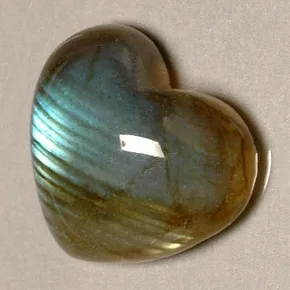
Labradorite
TRICLINIC

Labradorite

(Na,Ca)1-2Si3-2O8

Hardness
6–6.5
Refractive Index
1.560–1.568
Spec. Gravity
2.69–2.72
System
Triclinic
View Mineral
Labradorite is an important feldspar gemstone. It often displays a beautiful iridescent play of colors, which can move as the stone is rotated. Labradorite gemstones usually have a dark base color with metallic-looking color plays of blue, green, yellow, and red. This iridescent effect is commonly known as labradorescence, and is named after this stone. It is caused by internal fractures that reflect light back and forth, dispersing it into different colors.

About

Labradorite is named after the Canadian province of Labrador, the classic locality of this gemstone. Labradorite is often heavily flawed with internal dark lines and streaks; stones that are clean of flaws are rare. Some stones have a greater labradorescence effect then others, and a greater play of color increases the value of the Labradorite. A new reddish gemstone popularly called "Andesine" has recently sprung up on the gemstone market; this gemstone is formed by synthetically diffusing certain Labradorite with copper. Care should be handled with Labradorite, as it is sensitive to pressure and can easily crack or chip.

Uses

Labradorite is used as cabochons and beads, mainly for necklaces and bracelets, but is also faceted for rings and cut into ornamental objects and spheres.

Varieties

common  ·  uncommon

  • Spectrolite— Variety of Labradorite from Finland that displays a schiller color effect with intense colors such as dark red, orange, yellow, blue, and green.
  • Red Labradorite— Describes the gemstone Andesine, which is essentially Labradorite that has been artificially colored to a reddish tone by diffusion treatment with copper.

Treatments & Enhancements

Labradorite gemstones are natural and not treated or enhanced. A new gemstone form given the term Andesine is laboratory-produced by subjecting Labradorite to diffusion treatment.

Sources

The main sources of Labradorite are Canada (Labrador and Newfoundland), Finland, Ukraine, Madagascar, and Australia.

Similar Gemstones

The color effect of Labardorite distinguishes it from all other gemstones.

Further Reading

Faceted

In the Rough