
About
Inclusions of tiny, slender, parallel Rutile needles in Ruby cause a polished gem to exhibit asterism. A Ruby displaying asterism is known as a "Star Ruby", and if transparent can be very highly prized. Star Rubies exists in six ray stars, though twelve ray stars are also known. Rubies must be have good transparency to possess gem value. Opaque or semi-opaque Rubies have relatively little value, even if they display asterism.
The same Rutile inclusions that are responsible for asterism in certain Rubies can also decrease transparency and cause a hazy effect known as silk. Though Ruby can be one the most expensive gemstones, it also comes in more dull opaque forms that are fairly inexpensive, and are often polished into cabochons. A unique gemstone form composed of opaque red Ruby in contrasting green Zoisite is well known from Tanzania, and is used as a minor gemstone and can be carved into ornaments.
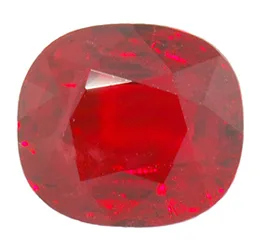
The color of Ruby is usually caused by minute inclusions of the metal chromium. These impurities are often responsible for causing a Ruby to fluorescent, which can be helpful in its identification. Ruby is also pleochroic, and will sometimes display a lighter and more intense color when viewed at different angles.
Ruby is a tough and durable gem, and the only natural gemstone harder than Ruby is Diamond. Despite this, Ruby is still subject to chipping and fracture if handled roughly, and care should be taken to ensure it is properly handled.
Ruby was first synthesized in 1902. The process of creating synthetic Ruby is known as the Verneuil process. Only experts can distinguish between natural and synthetic, lab-created Ruby.
Advertisement
Uses
Large Ruby gems are extremely rare and valuable. Fine colored Ruby with a deep red color and excellent transparency can reach several thousand dollars a carat. Synthetic Rubies are inexpensive and often used as a cheap substitute for natural rubies.
Ruby is the birthstone for July.
Varieties
✓ generally accepted · ✗ less commonly used
- Burma Ruby— Ruby from Burma; synonym of Burmese Ruby.
- Burmese Ruby— Ruby with an exceptional red color (usually but not necessarily from Burma). Occasionally also used to describe synthetic Ruby.
- Pigeon's Blood Ruby— Highly-desirable form of Ruby of a blood-red color with a hint of blue.
- Ruby Fuschite— Describes a dark red Ruby in a green Fuschite mica matrix found in India.
- Ruby Zoisite— Mixture of opaque red Ruby in green Zoisite from Tanzania. Ruby Zoisite has pretty contrast and is used as a minor gemstone, being polished into cabochons and carved into ornamental figures.
- Star Ruby— Well-known form of Ruby displaying asterism, most often in the form of a six-rayed star.
False Names
Adelaide Ruby
American Ruby
Arizona Ruby
Australian Ruby
Bohemian Ruby
California Ruby
Cape Ruby
Colorado Ruby
Elie Ruby
Montana Ruby
Rocky Mountain Ruby
Beside for Pyrope Garnet, other red gemstones have also been assigned false names in connotation with ruby. These include:
Alabandine Ruby - Almandine Garnet
Ancona Ruby - Rose Quartz
Balas Ruby - Pink to pale red Spinel
Brazilian Ruby - Pink Topaz
Copper Ruby - Cuprite
Garnet Ruby - Red Garnet
Geneva Ruby - Synthetic Ruby
Ruby Copper - Cuprite
Ruby Jack - Red Sphalerite
Ruby Garnet - Red Garnet
Ruby Spinel - Red Spinel
Siberian Ruby - Red Tourmaline
Spinel Ruby - Red Spinel
Verneul Ruby - Synthetic Ruby
Treatments & Enhancements
A recent practice in the gemstone industry is to fracture-fill Rubies to conceal flaws. This is done by heating them in molten lead glass which has a very similar refractive index to Ruby gemstones. Fracture-filled Rubies are significantly cheaper than their more authentic counterparts, and because of this one should always buy Ruby from a reputable dealer.
Sources
The most valuable Rubies with the finest natural color come from Mogok, Burma (Myanmar). There are strict trade embargoes and restrictions again Burma for its human rights violations, and several countries, especially the United States, ban any exports from this county. The Ruby mines of Mogok have been under the tight control of the Junta government; however, a new very significant Ruby source was discovered in Burma in 1992 in Mong Hsu. The color of these Rubies aren't as good as Mogok, but they too can be improved through heat treatment.
In 2000, new Ruby sources were discovered in Madagascar (in Vatomandry and Andilamena). These deposits turned out to be very extensive and productive, and Madagascar is now one of the leaders in Ruby output. Other important Ruby sources include Sri Lanka, India, Cambodia, Vietnam, Tanzania, and Mozambique. Other sources of Ruby include Afghanistan, Pakistan, Tajikstan, Australia, and the U.S. (North Carolina).