
About
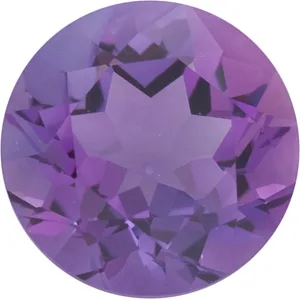
Amethyst comes from many different mining sources, some of which produce distinct color styles. For example, Amethyst from Uruguay has a deep purplish-blue color, as does Amethyst from Arizona. Amethyst from Russia, colloquially known as "Siberian Amethyst", is very deeply colored with reddish and bluish tints. It originates from deposits that have since been exhausted and therefore command a high price. Some dealers may sell deeply colored Amethyst from other locations as "Siberian Amethyst" to generate a higher selling value. African Amethyst is generally more deeply colored than South American Amethyst, and the label "African Amethyst" in the gem trade may be improperly used to describe a deeper color stone even if it didn't originate in Africa.
The color distribution of Amethyst is sometimes uneven, and this is often taken into account when cutting a stone. Care should also be taken with Amethyst as it is known to form curve shaped fractures if banged too hard. Some Amethyst from a few locations may slightly fade in color upon prolonged exposure to light.
Amethyst can occur in huge flawless crystals, and gems of all sizes have been faceted. Due to the abundance of Amethyst, it is usually clean and free of flaws or inclusions. Because of this, Amethyst with any visible flaws or inclusions should be avoided.
A natural mixture of purple Amethyst and golden Citrine has been coined with the trade name "Ametrine". (See the dedicated page for Ametrine page for more details.)
Uses
Amethyst is the birthstone of February.
Varieties
✓ common · ✗ uncommon
- African Amethyst— Amethyst originating from the continent of Africa. This term in the gem trade usually applies to deeply colored or darker Amethyst.
- Bolivian Amethyst— Amethyst from the South American country of Bolivia.
- Brazilian Amethyst— Amethyst originating from Brazil. This terms is also sometimes used in the gem trade to refer to any South American Amethyst.
- Green Amethyst— Light green gem form of Quartz that is artificially colored by heat-treating certain types of Amethyst. Also known as "Prasiolite".
- Siberian Amethyst — Term originally used to describe very deeply colored Amethyst from Siberia in Russia. May also be incorrectly used in the gem trade to describe any deeply colored Amethyst.
- Amethyst Quartz— Mixture of Amethyst and Milky Quartz (or clear Quartz). It
is purple on top and white or clear on the bottom. It may also be
banded purple and white. Amethyst Quartz is usually tumbled or polished into beads.
False Names
Oriental Amethyst - Purple Sapphire